Get ready for an exciting trip through our celestial neighborhood. The solar system is vast and full of wonders. It has many fascinating facts that will amaze you. From the huge size of the planets to the extreme temperatures and their mysterious movements, this journey will spark your curiosity.
As we explore these 10 interesting facts about the solar system, get ready for a journey to a world where the impossible becomes real. Discover the mysteries that have intrigued astronomers and stargazers for centuries. Unlock the secrets of the solar system’s complex web. Let’s start this adventure and uncover the cosmic wonders that have fascinated humans for so long.
Unveiling the Cosmic Wonders of Our Celestial Neighborhood
Our solar system is full of amazing celestial bodies, each with its own story. Exploring these worlds, we find a place of wonder and complexity. From big planets to small dwarf worlds, it’s a marvel of nature.
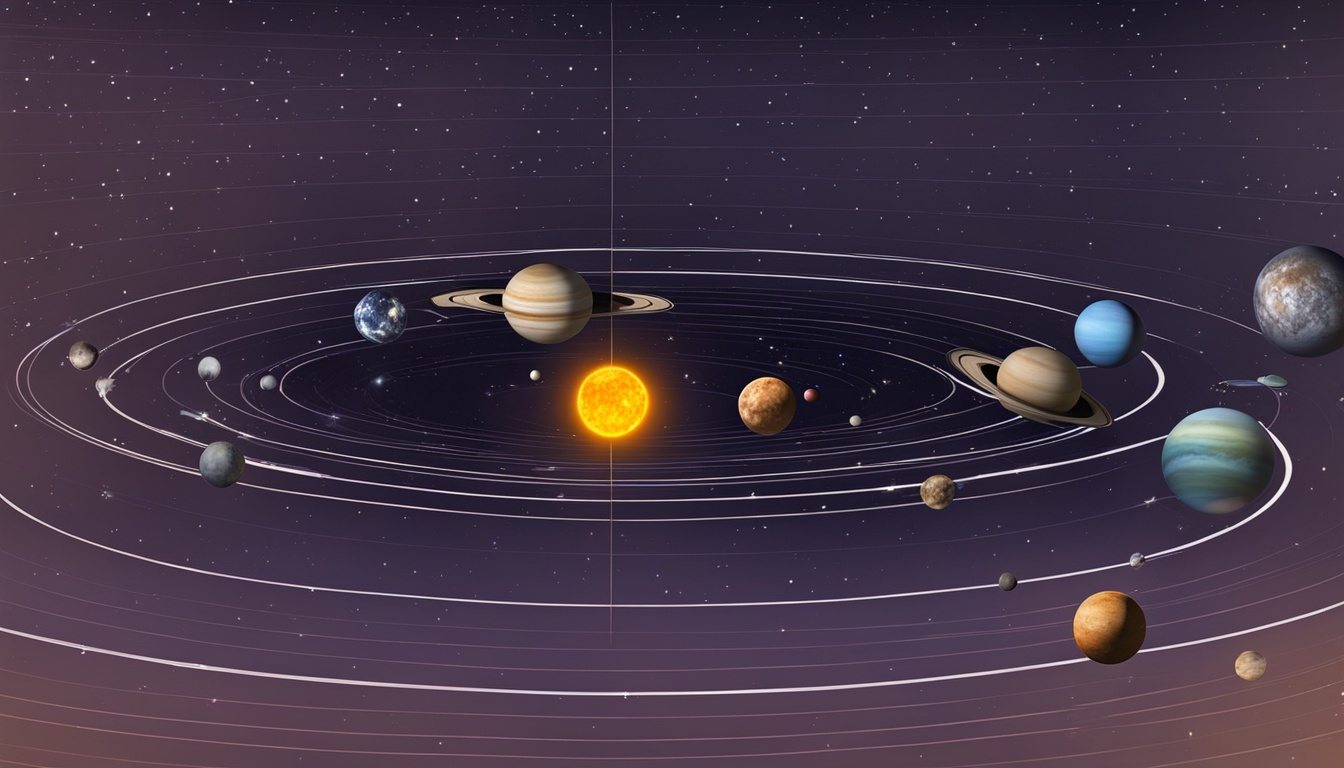
The Sun is at the center of our solar system. It gives energy and keeps the planets in balance. Around the Sun, there are eight major planets, each unique and fascinating. They range from Mercury’s heat to Neptune’s ice, showing the diversity of our solar system.
Our solar system also has smaller objects like asteroids, comets, and dwarf planets. These objects help us understand how our planets formed and changed over time. They give scientists lots of information to study the universe.
The Staggering Size and Scale of Our Solar System
Our solar system is huge and amazing, filled with huge celestial bodies. To understand its huge size, we need to look at the vast distances between these bodies.
Unraveling the Vast Distances Between Celestial Bodies
The planets in our solar system are far apart, with huge gaps between them. These gaps are measured in astronomical units (AU), which is the average distance from Earth to the Sun. For example, Earth and Mars can be as close as 0.39 AU or as far as 2.67 AU, depending on their orbits.
The distance from Earth to Neptune, the farthest planet, is a huge 30 AU. This shows just how vast our solar system is.
The solar system’s size is also mind-blowing. It stretches about 100 AU wide, from the Sun to the outer Kuiper Belt. If the Sun were a basketball, the solar system would stretch nearly half a mile in all directions. It’s hard to wrap our heads around how big our solar system is.
Scorching Temperatures and Icy Realms: Extremes Abound
Our solar system is full of amazing contrasts. It shows how different planetary climates can be. Mercury gets up to 800 degrees Fahrenheit (427 degrees Celsius) hot. On the other hand, the outer planets are icy cold.

Venus is like Earth’s twin but much hotter, with temperatures up to 900 degrees Fahrenheit (482 degrees Celsius). That’s hotter than melting lead. On the other side, Neptune and Uranus can get as cold as minus 350 degrees Fahrenheit (minus 212 degrees Celsius).
These extreme temperatures come from many factors. They include how far a planet is from the Sun, what’s in its atmosphere, and if it has greenhouse gases. Studying these extremes helps us understand how life can adapt in different places in our solar system.
Fun Facts: Quirky Curiosities That Defy Imagination
Our solar system is full of fun facts, quirky curiosities, and cosmic oddities. These things amaze and captivate us. From strange moons to unbelievable phenomena, there’s always something new to discover.
Did you know Venus spins the opposite way to most planets? It moves in reverse, so the sun rises in the west and sets in the east. This fact shows how our universe can surprise us.
Planets with rings are another oddity in space. Saturn’s rings are well-known, but Jupiter, Uranus, and Neptune also have their own rings. These icy, rocky rings show us the amazing things that can happen in our solar system.
Moons like Io, which spews lava, and the odd-shaped dwarf planet Haumea, show us how strange our solar system is. These facts remind us how much we still don’t know about the universe around us.
Moons Galore: Exploring the Diverse Lunar Landscapes
Our solar system is filled with a wide variety of moons, each with its own special features. From moons that spew lava to icy worlds, these moons show the amazing variety of celestial bodies. They give us a peek into the incredible range of these space companions.
From Lava-Spewing Satellites to Icy Marvels
The moons of our solar system are incredibly diverse in their landscapes. Take Io, a moon of Jupiter, for example. It’s a hot spot of volcanic activity, with lava flows and plumes that are bigger than any on Earth. On the other hand, Saturn’s moons like Enceladus and Titan have icy surfaces and lakes. This shows the huge variety of environments in our solar system’s moons.
These moons are not just fascinating; they also hold secrets about how planets formed and changed over time. By studying these moons, scientists can learn a lot about the early days of our solar system. They can also understand the ongoing changes that happen in space.
The Enigmatic Dance of Planetary Motions
Our solar system is like a cosmic dance, where planets move in a beautiful pattern. This dance follows the rules of planetary motion and celestial mechanics. It shows us how our solar system works.
Planets move in complex paths, including elliptical orbits and retrograde movements. Each planet, from hot Mercury to far Neptune, has its own path. These paths are shaped by gravity, momentum, and the Sun’s power.
These motions help us understand our solar system better. By studying how planets move, scientists learn about our solar system’s creation and evolution. They also learn about the forces that shape it.
The solar system shows us many fascinating movements. From Uranus’ retrograde motion to Jupiter’s moons, it’s full of surprises. By studying these movements, we learn more about the universe. We also appreciate the beauty of the cosmic dance.
Stunning Celestial Displays and Cosmic Fireworks
Get ready to be amazed by the stunning celestial displays and cosmic fireworks in our skies. From the mesmerizing aurora borealis to the captivating meteor showers, our solar system is full of awe-inspiring natural light shows. These shows never fail to amaze us.
Aurora Borealis and Meteor Showers: Nature’s Light Shows
The aurora borealis, or northern lights, is a beautiful display of colorful lights in the night sky. It happens when charged particles from the sun meet the Earth’s magnetic field. This creates a light show that can be soft and flowing or vibrant and bright.
Meteor showers are another amazing cosmic fireworks display. They happen when pieces from comets or asteroids enter the Earth’s atmosphere and burn up. This creates a beautiful display of shooting stars in the sky.
These celestial displays are not just beautiful. They also show us the dynamic nature of our solar system. By learning about the science behind them, we can appreciate our celestial environment more. We learn about the constant interactions between the Earth, the sun, and the universe.
Uncovering the Mysteries of Black Holes and Dark Matter
The universe is full of mysteries, and black holes and dark matter are two big ones. These mysteries grab the attention of scientists and fans of the stars. They could help solve some of the biggest mysteries of our solar system.
Black holes are fascinating cosmic objects. They form when huge stars collapse. These objects warp space and time in ways we don’t understand. Scientists are trying to learn more about them, from how they start to their effects on the universe.
Dark matter is also a big mystery. It’s a substance that makes up most of the universe but we can’t see it. It affects how galaxies and our solar system work. Finding out what dark matter is could change how we see the universe.
Exploring black holes and dark matter brings us new discoveries. These discoveries challenge what we thought we knew and expand our understanding. This shows how curious humans are about the universe and its secrets.
Extraterrestrial Explorations: The Quest for Life Beyond Earth
Humanity’s interest in space keeps growing, making the search for alien life exciting. Scientists worldwide are working hard to understand our solar system and beyond. They look for planets that could support life and might have aliens.
Space missions and new tech help scientists search the solar system for signs of life. They check the icy moons of Jupiter and Saturn and the dry lands of Mars. These places might seem harsh, but they could actually support life.

Scientists study planets and moons that might have what life needs, like water and a good atmosphere. They look at the temperatures too. This research helps us understand how life could start and survive in different places.
The hunt for life outside Earth excites people everywhere. It makes scientists curious and leads to new discoveries. Every new find makes finding aliens more likely, changing how we see the universe and our place in it.
Cosmic Collisions and Celestial Catastrophes
Our solar system’s history is full of dramatic cosmic collisions and celestial catastrophes. These events have deeply shaped the planets, moons, and other bodies we see today. They give us a peek into the stormy past of our cosmic home.
Unraveling the Violent History of Our Solar System
There’s a lot of evidence of past cosmic collisions in our solar system. Craters on planets and moons show the impact of asteroids and meteorites. These impacts have been key in creating the diverse landscapes we see, from Mercury’s rugged terrain to the icy moons of the outer planets.
By studying these impact sites, scientists can piece together our solar system’s history. This reveals a past filled with cosmic violence. These events changed the planets’ looks, atmospheres, magnetic fields, and even if they had water and other important elements.
Learning about these celestial catastrophes helps us understand our solar system’s dynamic nature. It satisfies our curiosity and gives us insights for future space exploration. This knowledge is crucial in finding new worlds that might support life.
Future Frontiers: Unveiling the Secrets of Deep Space
Looking up at the stars, we feel drawn to the mysteries of deep space. The future of space exploration is full of promise. New technologies will help us explore the unknown more than ever.
Telescopes, robots, and spacecraft are ready to go further than before. They will help us learn about our solar system and maybe even find life beyond Earth.
New telescopes like the James Webb Space Telescope will show us the early universe. They will help us understand how galaxies formed and changed over time. Missions like the Europa Clipper and Dragonfly will explore icy moons that could have life.
Space technology is getting better, bringing us closer to exploring other planets. We might soon have people living on the Moon, leading to missions to Mars and beyond. These missions will expand our knowledge and inspire others, keeping our curiosity alive.